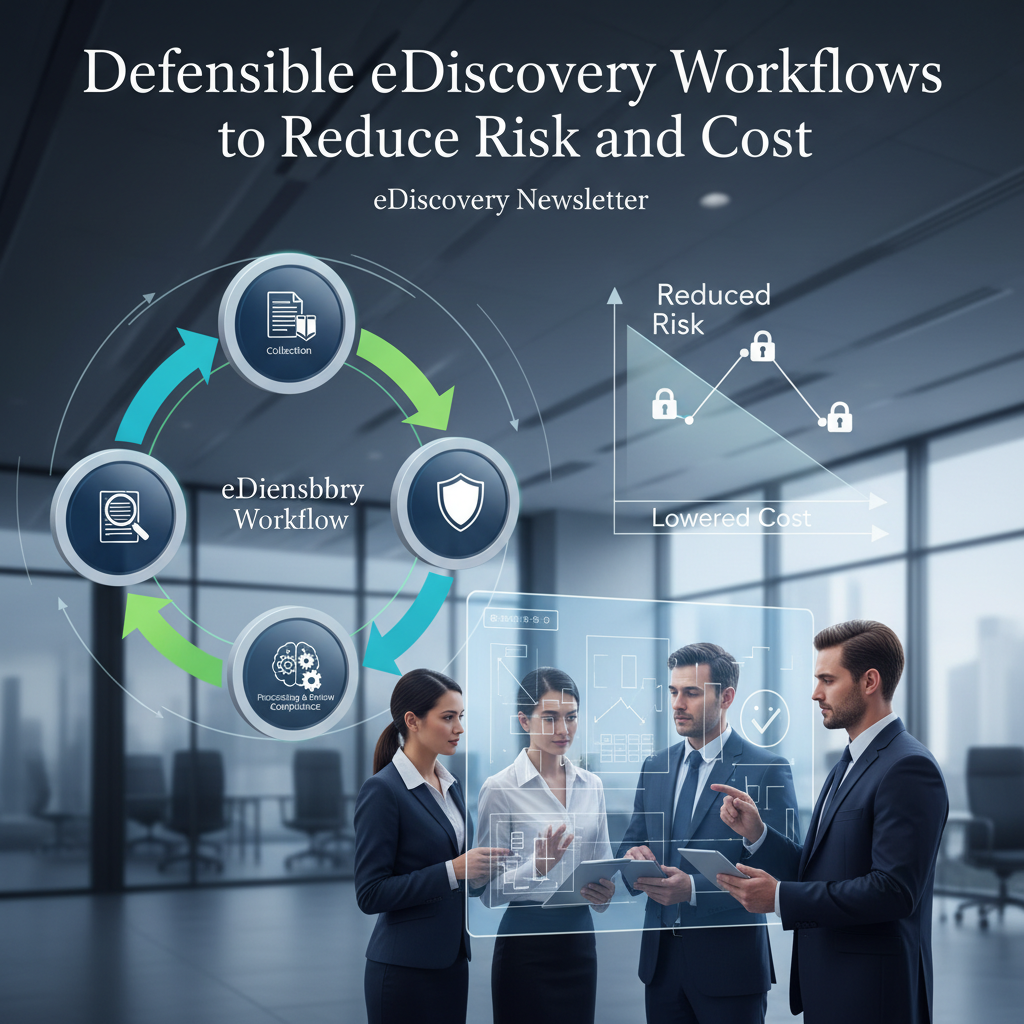
From Custodian to Courtroom: How Defensible eDiscovery Workflows Reduce Risk and Cost
Discovery is no longer just about sifting through email. Today’s matters turn on mobile content, cloud collaboration platforms, ephemeral messaging, and system-generated telemetry. For Atlanta-based legal teams handling matters across the Southeast and nationwide, defensible eDiscovery and digital forensics are now strategic imperatives. When workflows are designed for legal defensibility from day one—preservation to production—teams reduce risk, accelerate insight, and control cost while standing up to judicial scrutiny in state and federal courts.
Table of Contents
- The Modern eDiscovery & Forensics Landscape
- Key Opportunities and Risks
- Devices, Data Sources, and Collection Methods
- eDiscovery Workflows & Technology Solutions
- Best Practices for Defensible eDiscovery
- Industry Trends and Future Outlook
- Conclusion & Call to Action
The Modern eDiscovery & Forensics Landscape
Courts and regulators expect parties to manage electronically stored information (ESI) competently and proportionally. That expectation spans regional disputes in Georgia state courts, complex multi-district litigation, governmental investigations, and cross-border regulatory inquiries. The combination of growing data volumes, expanding data types, and evolving privacy frameworks has elevated the importance of forensics-informed eDiscovery workflows that are repeatable, auditable, and defensible.
Types of Data Sources
- Email and archives (Microsoft 365/Exchange, Google Workspace/Gmail)
- Collaboration platforms (Teams, Slack, Zoom, Webex, Google Chat)
- File shares and endpoints (Windows, macOS, Linux; desktops and laptops)
- Mobile devices (iOS, Android; corporate and BYOD)
- Cloud and SaaS repositories (OneDrive, SharePoint, Box, Dropbox, Salesforce)
- Structured systems (databases, ERP, HRIS, CRM) and log/telemetry data
- Legacy media and backups (tapes, removable drives, snapshots)
Forensic Soundness and Chain of Custody
Forensic soundness means collections preserve data integrity, metadata, and context—without altering source evidence. Chain of custody documents who handled data, when, and how. Courts often look for:
- Clear preservation steps (legal holds, system-level safeguards)
- Validated tools and methods (forensic imaging, hashing, targeted exports)
- Comprehensive documentation (from identification through production)
Legal defensibility: If challenged, your process must be explainable, repeatable, and supported by contemporaneous documentation. Align with the Federal Rules of Civil Procedure (including Rule 26 on proportionality and 37(e) on ESI spoliation) and applicable state rules, guided by principles such as The Sedona Conference.
Key Opportunities and Risks
Opportunities
- Early Case Assessment (ECA): Rapid scoping, keyword and analytics-driven culling, and sampling to clarify custodians, timelines, and central issues.
- Cost Control: Right-sizing collections and leveraging analytics to minimize downstream hosting and review spend—the largest budget driver.
- Faster Insights: Quick-turn timelines matter in TROs, internal investigations, and regulatory responses; well-orchestrated workflows accelerate time-to-fact.
- Strategic Advantage: Transparent, repeatable processes streamline meet-and-confer negotiations and strengthen motion practice.
Risks
- Spoliation: Failure to preserve relevant ESI can trigger sanctions under Rule 37(e) and corresponding state rules.
- Incomplete Collections: Missing sources (e.g., mobile chats, private channels, or shared mailboxes) undermines completeness and credibility.
- Over-Collection: Unfocused collections inflate processing and review volumes, costs, and privilege risk.
- Privacy and Cross-Border Issues: Jurisdictional constraints (GDPR, UK DPA, CPRA) require targeted, compliant methods.
- Poor Vendor or Tool Selection: Inadequate capabilities or documentation gaps can compromise timelines and defensibility.
Common pitfalls: Ad hoc preservation notices; collecting only email while ignoring Teams/Slack; exporting from the live system without logging parameters; failing to hash data or record time zone normalization; and neglecting mobile and BYOD considerations.
Devices, Data Sources, and Collection Methods
Every matter balances speed, scope, defensibility, and cost. Selecting the right collection strategy—targeted export versus full forensic image; remote versus on-site—depends on data types, legal hold status, timelines, and technical constraints.
| Source | Examples | Typical Method | Defensibility Notes |
|---|---|---|---|
| Workstations/Servers | Windows, macOS, file shares | Forensic image or targeted logical export | Use validated tools; capture system metadata; hash evidence |
| Mobile Devices | iOS, Android (corporate/BYOD) | Logical/advanced logical extraction; sometimes physical | Address privacy; document consent/policy; preserve chat with attachments and timestamps |
| Cloud Email/Files | M365, Google Workspace, Box, Dropbox | API-based targeted export with audit logs | Record scopes, filters, and export parameters; preserve folder paths and permissions |
| Collaboration Chats | Teams, Slack, Zoom Chat | Admin/API export; channel and private/DM capture | Maintain conversation threading, reactions, edits/deletes, and time zones |
| Structured Data | ERP, CRM, HRIS | Scoped database export; reporting; snapshots | Define fields, date ranges, joins; create data dictionaries; validate counts |
| Backups/Legacy Media | Tapes, snapshots, archives | Selective restoration; targeted recovery | Document restore sources, dates, and exceptions; avoid altering originals |
Forensic vs. Targeted Collections
- Forensic Imaging: Bit-by-bit capture preserves deleted items, system artifacts, and full metadata—useful for investigations, disputed authenticity, and spoliation concerns.
- Targeted Export: Scoped, defensible exports reduce volume and cost—ideal for proportional civil matters or time-sensitive requests.
Preservation obligations: Trigger legal holds promptly; suspend auto-deletion; preserve key accounts, devices, and repositories. Work with counsel and IT to define scope and cutoffs aligned with proportionality.
Remote and On-Site Acquisition
- Remote: API-based cloud collections, endpoint agents, and courier-assisted device kits reduce travel and speed response.
- On-Site: Critical for air-gapped systems, large servers, or sensitive facilities. Local Atlanta and Southeast coverage can accelerate turnaround while minimizing disruption.
| Stage | Objective | Key Documentation |
|---|---|---|
| Identification | Map custodians, systems, data owners | Data maps, custodian interviews, system lists |
| Preservation | Prevent loss/alteration of ESI | Legal holds, auto-delete suspensions, hold acknowledgments |
| Collection | Acquire data defensibly | Tool logs, hash reports, scope parameters, chain-of-custody forms |
| Validation | Confirm completeness and integrity | Hash verification, item counts, exception logs |
eDiscovery Workflows & Technology Solutions
After collection, data moves through processing, analytics, review, and production. The right platform and hosting model can meaningfully reduce cost and cycle time while maintaining defensibility.
Processing, Filtering, Analytics, and Review
- Processing: De-duplication, de-NISTing, metadata extraction, OCR, time zone normalization, threading, and exception handling.
- Filtering: Date and custodian filters, search term testing, file-type exclusions, and near-duplicate clustering.
- Analytics: Email threading, communication mapping, concept clustering, and technology-assisted review (TAR/CAL) to prioritize likely-relevant material.
- Review: Workflows for first pass, privilege, QC, and production validation, with audit logs and reporting.
| Model | Description | Strengths | Considerations |
|---|---|---|---|
| On-Premises | Client hosts within their environment | Control, data sovereignty, integration with internal IT | CapEx, maintenance burden, scalability limits |
| Private Cloud | Vendor-managed, single-tenant hosting | Security isolation, scalable resources, expert administration | Ongoing Opex, vendor SLAs critical |
| Managed Hosting | Vendor platform with managed services | Speed to value, elastic capacity, turnkey workflows and reporting | Define roles, access, and data return/expunge processes |
Review Platforms and Managed Services
- Platforms: Modern review tools support analytics, TAR/CAL, continuous active learning, privilege identification, redactions (including audio/video), and integrated productions.
- Managed Services vs. In-House: Managed services provide experienced project management, standardized playbooks, and cost transparency. In-house teams may prefer direct control for repeatable matters with steady volume. Hybrid models are common.
Defensibility checkpoint: Maintain documented processing settings, search term testing logs, TAR protocols, QC sampling methods, and production specifications (Bates, load files, metadata fields, redaction reasons).
Forensic and eDiscovery Tools Snapshot
| Tool Category | Examples | Use Case | Defensibility Considerations |
|---|---|---|---|
| Endpoint Forensics | EnCase, FTK, X-Ways | Disk imaging, artifact analysis | Hash verification, chain-of-custody, repeatable methods |
| Mobile Forensics | Cellebrite, Magnet AXIOM | Chat, app data, extractions | Scope approvals, consent logs, time zone accuracy |
| Cloud Collections | Microsoft Purview, Google Vault, Slack eDiscovery APIs | Targeted, auditable exports | Record query scopes, filters, admin permissions |
| Processing & Review | Relativity, Reveal, DISCO, Nuix | Processing, analytics, TAR, review | Document settings, TAR protocols, audit logs, QC reports |
Best Practices for Defensible eDiscovery
Preservation and Legal Holds
- Issue clear, timely legal holds; obtain acknowledgments; track compliance; reissue as scope evolves.
- Suspend auto-deletion and retention schedules that affect identified custodians and systems.
- Coordinate with IT to preserve cloud accounts (mailboxes, Teams/Slack workspaces, OneDrive/SharePoint sites) and endpoint images when warranted.
Documentation and Chain of Custody
- Use standardized collection forms capturing custodian, device IDs, tool versions, parameters, hashes, and handlers.
- Maintain end-to-end audit trails from collection through processing, review, and production.
- Retain platform logs, API export reports, and processing exception lists.
Proportionality Under Applicable Rules
- Right-size scope based on the importance of issues, amount in controversy, access to information, party resources, and burden versus benefit.
- Leverage sampling, analytics, and iterative search term testing to reduce volume without sacrificing completeness.
- Document rationale for decisions; use this record in meet-and-confer discussions and, if necessary, motion practice.
Collaboration Between Counsel, IT, and Vendors
- Hold early case scoping sessions with counsel, IT, and your eDiscovery vendor to map systems and prioritize sources.
- Use playbooks and SLAs: roles, timelines, escalation paths, and standardized production specifications.
- Address privacy and cross-border constraints up front, including data residency and transfer mechanisms.
Best practice spotlight: Align case strategy with data reality. Start with a defensible hypothesis, test it with ECA analytics, and iterate. A small, well-documented collection often outperforms broad, unfocused sweeps in both cost and credibility.
Industry Trends and Future Outlook
- Mobile and Cloud-First Evidence: Chats, reactions, edits, emojis, and ephemeral channels are central evidence. Tools must preserve context, threads, and time zones.
- Increasing Judicial Scrutiny: Courts expect transparency in search methodologies, TAR workflows, and production specifications. Sanctions risk remains for spoliation and discovery misconduct.
- Cost Transparency and Alternative Pricing: Matter-based budgets, subscription models, and managed services increase predictability for corporate clients.
- Regional Expertise: Local response capabilities (e.g., rapid on-site collections in the Atlanta metro and throughout the Southeast) paired with national hosting and review scale is a winning combination.
- Vendor Specialization: Sector-savvy teams (healthcare, financial services, manufacturing, technology) bring playbooks for common systems and data types, accelerating outcomes.
| Phase | Primary Activities | Key Outputs |
|---|---|---|
| Identification | Interviews, data mapping, scoping | Custodian list, system inventory, scope memo |
| Preservation | Legal holds, retention suspensions | Hold notices, acknowledgments, preservation plan |
| Collection | Forensic/targeted acquisition | Chain-of-custody, hash logs, collection report |
| Processing | De-dup, metadata, OCR, threading | Processed dataset, exception log |
| Review & Analysis | TAR/CAL, privilege, QC, analytics | Review coding, privilege logs, QC reports |
| Production | Exports, endorsements, validation | Bates-stamped sets, load files, production log |
| Presentation | Hearing/trial prep, exhibit management | Exhibit lists, demonstratives, trial binders |
Conclusion & Call to Action
Defensible eDiscovery and digital forensics transform risk into advantage. By combining forensics-grade collections, proportionate scoping, and analytics-driven review with clear documentation and auditability, legal teams can reduce cost, accelerate timelines, and deliver results that withstand scrutiny—from the meet-and-confer through motions and trial. An experienced Atlanta-based partner with national reach helps you navigate local court expectations, multi-jurisdictional matters, and evolving privacy landscapes while keeping your program efficient, transparent, and defensible.
Ready to strengthen your eDiscovery and digital forensics strategy? Contact Relevant Data Technologies today to discuss defensible, efficient, and scalable discovery solutions.