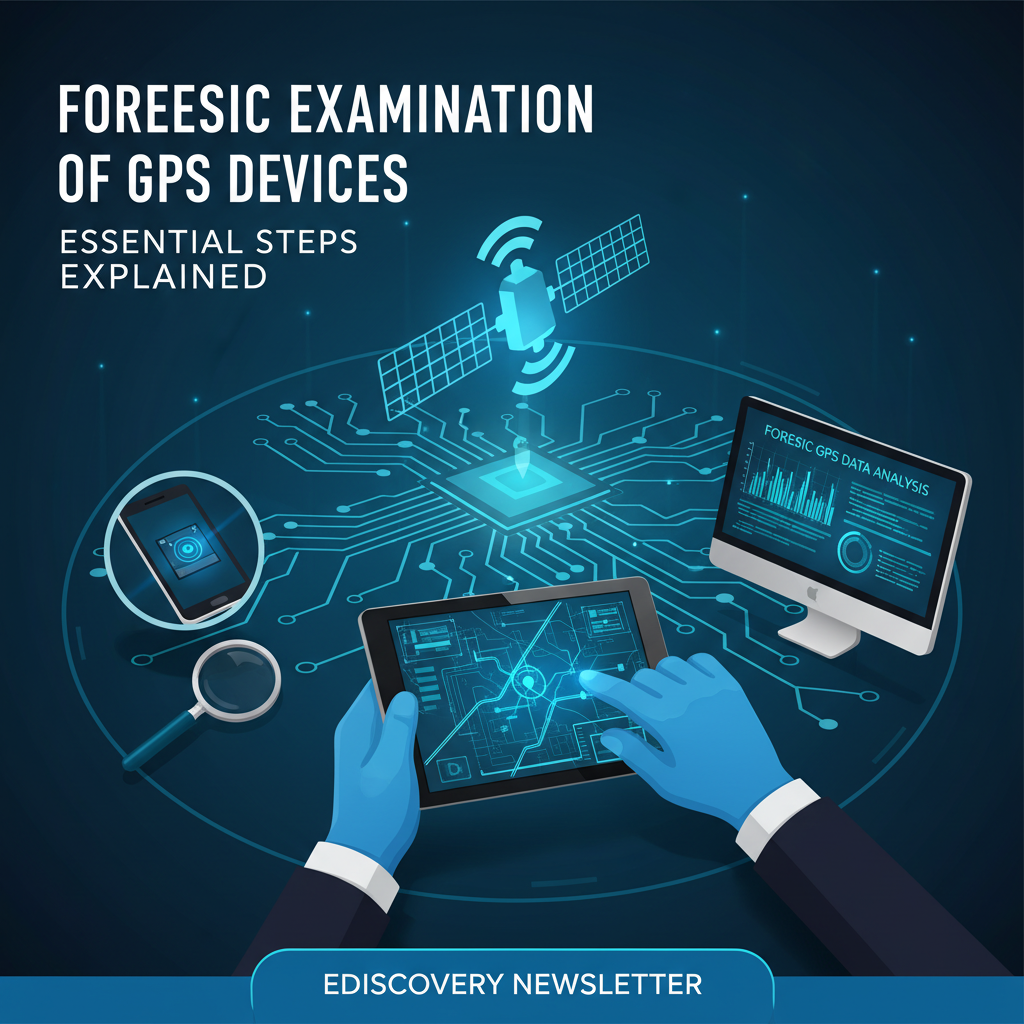
Forensic Examination of GPS Devices: Key Steps
Location evidence has become a central thread in litigation, investigations, and regulatory matters—from trucking accidents and fraud to employment disputes, trade secret misappropriation, and white-collar crime. GPS data can corroborate or contradict testimony, establish timelines, and link people or assets to places with precision. As an Atlanta-based eDiscovery and digital forensics partner supporting regional, national, and multi-jurisdictional matters, we see GPS artifacts emerge in cases across industries and practice areas. This article explains how attorneys, litigation support teams, and legal operations can leverage defensible GPS forensics within a modern eDiscovery program.
Table of Contents
- The Modern eDiscovery & Forensics Landscape
- Key Opportunities and Risks
- Devices, Data Sources, and Collection Methods
- Forensic Examination of GPS Devices: Key Steps
- eDiscovery Workflows & Technology Solutions
- Best Practices for Defensible eDiscovery
- Industry Trends and Future Outlook
- Conclusion & Call to Action
The Modern eDiscovery & Forensics Landscape
Today’s matters require navigating a mosaic of structured and unstructured data. Traditional sources (email and file shares) are now joined by mobile devices, vehicle systems, collaboration platforms, SaaS applications, and analytics logs. GPS information threads through many of these platforms—sometimes explicit (e.g., a Garmin track), often embedded (e.g., photo EXIF data, Slack mobile location, telematics platform records).
Two principles anchor defensible GPS forensics:
- Forensic soundness: Acquire and analyze data without altering it, using repeatable methods and validated tools.
- Chain of custody: Document who collected what, when, where, how, and under whose authority, including hashes and media tracking.
Key Opportunities and Risks
Opportunities
- Early Case Assessment (ECA): Early review of location chronologies can validate theories, inform motion practice, and shape discovery scopes.
- Cost control: Targeted GPS collections and early analytics reduce terabytes of noise and accelerate review.
- Faster insights: Visual timelines and map overlays quickly convey movement, proximity, and gaps.
- Strategic advantage: Correlating GPS with messages, calls, and enterprise logs creates compelling narratives.
Risks
- Spoliation: Powering on a device or allowing cloud sync can alter or purge data.
- Incomplete collections: Missed cloud backups or vehicle modules can leave critical gaps.
- Over-collection: Sweeping captures can trigger privilege/privacy concerns and inflate cost.
- Privacy and cross-border: GPS trails may include protected personal data subject to state, federal, or international restrictions.
- Poor tool selection: Using the wrong tool can fail to decrypt, parse, or properly validate artifacts.
Legal Defensibility Highlight: Courts increasingly expect counsel to understand the sources and limitations of location data. Demonstrating a documented, proportional approach to GPS evidence—paired with expert methodology and chain-of-custody controls—reduces motion practice risk and enhances credibility.
Devices, Data Sources, and Collection Methods
GPS evidence can originate from multiple devices and services. Counsel should expect multi-source reconciliation to confirm movement and timelines.
| Device / Source | Common Artifacts | Acquisition Approach | Key Considerations |
|---|---|---|---|
| Standalone GPS (Garmin, TomTom) | Tracks, routes, waypoints, GPX/FIT/NMEA logs, last destinations, search history | Physical imaging of flash; logical extraction via vendor/forensic tools | Time zone/datum, file system parsing, device clock drift |
| Vehicle Infotainment/Telematics (OEM systems, fleet units) | Trip history, paired devices, contacts, call logs, navigation searches, Wi‑Fi/Bluetooth identifiers | Specialized vehicle forensic tools; module-specific procedures | Safety, power management, post-reset data loss, encryption, legal ownership |
| Mobile Phones/Tablets | Location services logs, app-based trails (maps, rideshare, fitness), photo EXIF | Forensic mobile tools (logical, file-system, or physical); cloud data via legal process | OS encryption, user consent, MDM, privacy constraints |
| Cloud Platforms (Google Location History, Apple Significant Locations, Garmin/TomTom cloud, OnStar) | Historical location, trips, geofences, synced device data | Provider exports, APIs, or legal process; user-authorized downloads | Retention policies, cross-border data, account credentials, consent |
| Wearables/Drones/IoT | Route paths, flight logs, sensor data, timestamps | Device/app/cloud acquisition; vendor-specific parsers | Proprietary formats, firmware versions, export options |
Forensic vs. Targeted Collections
| Approach | When to Use | Benefits | Trade-offs |
|---|---|---|---|
| Forensic (Full Image) | Potential criminal exposure, complex disputes, authenticity challenges, spoliation risks | Maximizes completeness; supports validation and re-analysis | Higher cost/time; broader privacy footprint |
| Targeted (Scoped) | Clear date/device scope; low risk of later disputes | Faster and more proportional; cost-efficient | Risk of missing artifacts outside initial scope |
Preservation Obligation: On notice of potential disputes, suspend automated deletion and avoid powering on or connecting GPS-capable devices to networks. Consider Faraday containment for mobile devices; preserve relevant cloud accounts; and document device status at seizure.
Forensic Examination of GPS Devices: Key Steps
Defensible GPS examinations follow structured, repeatable stages. Below we outline a practitioner’s workflow tailored for counsel oversight and proportional discovery.
- Identify scope (devices, accounts, date ranges)
- Preserve and seize (document state; prevent network activity)
- Forensic acquisition (validated tools; generate hashes)
- Parsing and normalization (GPX/KML/CSV; map projections)
- Correlation with communications and enterprise logs
- Analytics and visualization (timelines, heatmaps)
- Attorney review and production (load files with metadata)
1) Scoping and Legal Authority
- Confirm ownership/possession of devices (corporate vehicle vs. personal) and applicable privacy policies.
- Define temporal and geographic scope tied to claims/defenses to support proportionality.
- Identify cloud components (e.g., Google Location History, OEM telematics portals) and whether legal process or consent is required.
2) Preservation and Seizure
- Record device status (powered on/off, battery level, external media, installed SIMs).
- Prevent changes: isolate from networks; avoid navigation app launches; keep vehicle ignition off unless procedures require accessory power.
- Label, photograph, and serialize devices; capture vehicle VIN and module info when applicable.
3) Forensic Acquisition
- Use validated tools suited to the device and OS/firmware, following vendor and SWGDE/NIST guidance.
- Create forensic images or targeted logical exports with cryptographic hashes; document any read/write blockers or interface cables.
- For vehicles, follow module-specific procedures to prevent airbag/FMVSS issues and avoid data loss on power interruption.
4) Parsing and Normalization
- Extract tracks, routes, waypoints, searches, device pairings, Wi‑Fi/Bluetooth identifiers, and trip logs.
- Normalize to standard geospatial formats (GPX, KML, CSV) and time standards (UTC with offset) to mitigate clock drift and DST issues.
- Document coordinate systems and datums; reconcile any GPS week rollover or leap-second anomalies.
5) Correlation and Validation
- Cross-check with independent sources: call detail records, messaging timestamps, toll/ALPR hits, access control logs, fuel receipts, CCTV.
- Evaluate consistency: speed and distance vs. expected road networks; device movement vs. user calendar or time cards.
- Assess gaps: explain periods with no fix (e.g., indoor parking) or potential data suppression (e.g., resets or retention limits).
6) Analytics and Visualization
- Create event timelines aligning location with communications and key case events.
- Build heatmaps and route overlays to quickly show proximity or pattern of life.
- Summarize findings into attorney-friendly charts with sources, assumptions, and limitations stated.
7) Reporting and Production
- Generate defensible reports with methodology, tools, hash values, and chain-of-custody appendices.
- Produce normalized files (CSV/GPX/KML) and load-ready metadata for review platforms; include map snapshots where appropriate.
- If necessary, prepare expert declarations explaining reliability and error sources (multipath, urban canyons, device drift).
Common Pitfalls in GPS Forensics: 1) Powering on devices and triggering sync or deletion; 2) Ignoring cloud-synced accounts; 3) Failing to normalize timestamps/time zones; 4) Overlooking vehicle modules beyond the head unit; 5) Relying on a single tool without cross-validation; 6) Producing only images without structured metadata fields for review.
Representative Tools for GPS Examinations
| Tool Category | Examples | Strengths | Notes |
|---|---|---|---|
| Mobile Forensics Suites | Cellebrite, Magnet AXIOM, XRY, Oxygen | Broad device support; parses app-based location; cloud modules | Licensing and version parity matter; test parsers on sample data |
| Vehicle/Infotainment Forensics | Specialized vehicle extraction platforms | Module-aware workflows; infotainment artifacts and pairings | Model/firmware dependent; follow safety protocols |
| Workstation Forensics | EnCase, FTK, Autopsy/Sleuth Kit | Imaging and file-system analysis; scriptable parsing | Useful for standalone GPS units and SD cards |
| Geo Utilities & GIS | GPSBabel, QGIS/ArcGIS | Format conversion; spatial analysis; map rendering | Supports advanced visualizations and projections |
eDiscovery Workflows & Technology Solutions
Location evidence becomes most persuasive when it is integrated into the broader discovery workflow and reviewed alongside communications, documents, and structured logs.
Processing, Filtering, and Analytics
- Normalize GPS artifacts to CSV with fields like device ID, latitude, longitude, altitude, speed, accuracy, timestamp (UTC), time offset, and source.
- Apply date ranges and bounding boxes for proportional review; tag events by geofences (e.g., worksite, facility).
- Use timeline analytics and communication threading to correlate people, places, and events.
Hosting Models
| Model | Use Case | Pros | Considerations |
|---|---|---|---|
| On-Prem | Highly sensitive investigations; strict data residency | Direct control; internal security controls | CapEx, staffing, scalability limits |
| Private Cloud | Predictable matters; repeatable workflows | Elastic capacity; strong security; cost predictability | Vendor SLAs and regional availability |
| Managed Hosting | Variable caseload; tight timelines | Rapid spin-up; managed performance and support | Opex costs; need clear governance and reporting |
Review Platforms and Analytics
- Load GPS CSVs as structured ESI with custom fields and map thumbnails for quick understanding.
- Leverage dashboards to visualize geospatial timelines, highlight hotspots, and link back to underlying evidence.
- Enable saved searches by geofence, device ID, or speed thresholds to focus on facts in dispute.
Managed Services vs. In-House
- Managed Services: Ideal for firms/corporate legal teams seeking predictable SLAs, standardized SOPs, and expert oversight across matters.
- In-House: Appropriate where caseload justifies dedicated staff and tools; consider co-sourcing for specialized GPS/vehicle modules.
Best Practices for Defensible eDiscovery
Preservation and Legal Holds
- Issue holds that specifically call out GPS-capable devices, vehicle systems, and cloud accounts; suspend auto-deletion.
- Provide simple, written custodian instructions, including not to factory reset, delete app data, or update firmware.
- Coordinate with fleet managers or IT on vehicle and telematics retention.
Documentation and Chain of Custody
- Maintain logs of device condition, serials/VINs, acquisition settings, tool versions, and hashes.
- Photograph device screens, connectors, and installed media; capture module screenshots where feasible.
- Track media transfers and analyst access in a centralized evidence registry.
Proportionality and Scope
- Tie GPS date ranges and geofences to the claims, using ECA results to refine scope.
- Favor targeted extractions when full imaging isn’t necessary, with a plan to escalate if disputes arise.
Collaboration
- Engage counsel, IT/fleet teams, and the forensic vendor early to align on logistics and safety.
- Address cross-border transfers and privacy obligations up front; consider regional hosting (e.g., Southeast U.S.) for sensitive data.
Defensibility Tip: Pair every substantive opinion with a footnote-equivalent reference in your report: tool versions, standards consulted (e.g., SWGDE guidance, NIST mobile forensics), and validation tests performed. This anticipates Daubert challenges and educates the court.
Industry Trends and Future Outlook
- Mobile and cloud-first evidence growth: Wearables, IoT, and app ecosystems continue to expand the sources of location data.
- Judicial scrutiny: Courts expect specificity on data sources, acquisition methods, and limitations—especially with location precision and error margins.
- Cost transparency: Matter-based pricing, dashboards, and KPIs for cycle time and cost-to-insight are becoming standard.
- Regional specialization: Localized expertise matters for fast on-site response (e.g., vehicle acquisitions in metro Atlanta and the Southeast) while scaling nationally for multi-state fleets and cloud accounts.
Conclusion & Call to Action
GPS evidence can make or break factual narratives. The difference between insight and noise is a defensible, documented approach—one that preserves ephemeral data, chooses the right tools, and integrates location artifacts into a coherent eDiscovery workflow. Whether you are advising on preservation strategy, overseeing vendors, or pressing for cost control, a methodical GPS forensic process delivers speed, defensibility, and strategic clarity.
As an Atlanta-based eDiscovery and forensics team, we support rapid response across the Southeast while handling national and multi-jurisdictional matters with consistent quality and reporting. If your case involves movement, timing, or presence, it likely involves GPS—and the time to plan is now.
Ready to strengthen your eDiscovery and digital forensics strategy? Contact Relevant Data Technologies today to discuss defensible, efficient, and scalable discovery solutions.