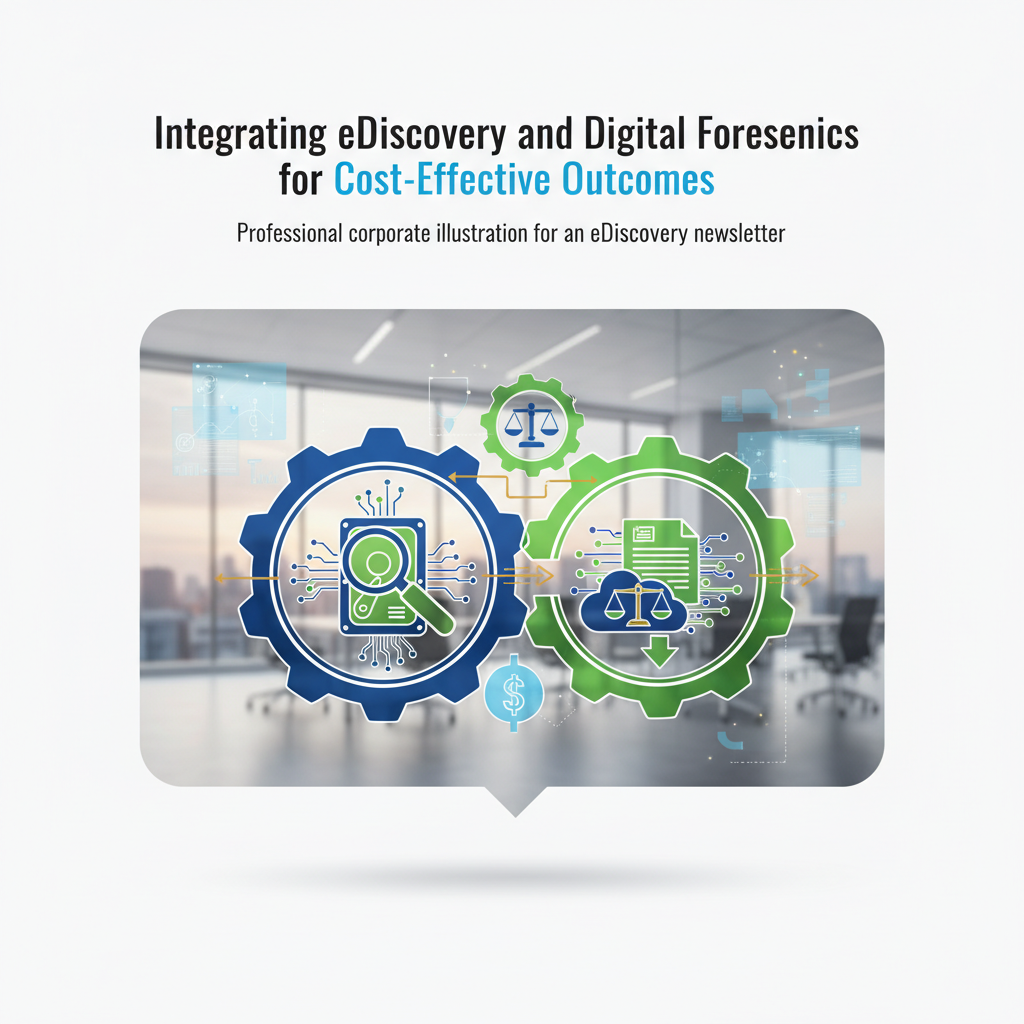
Integrating eDiscovery and Digital Forensics for Defensible, Cost-Effective Outcomes in a Mobile-and-Cloud World
From our vantage point as an Atlanta-based eDiscovery and digital forensics partner supporting regional, national, and multi-jurisdictional matters, we see a common challenge: evidence is everywhere, timelines are tight, and the cost of missteps—whether spoliation, over-collection, or inefficient review—can be severe. This article is designed for attorneys, litigation support professionals, and legal operations teams who oversee discovery strategy, cost control, and defensibility, and who need a practical roadmap for modern investigations and litigation.
Table of Contents
- Introduction
- The Modern eDiscovery & Forensics Landscape
- Key Opportunities and Risks
- Devices, Data Sources, and Collection Methods
- eDiscovery Workflows & Technology Solutions
- Best Practices for Defensible eDiscovery
- Industry Trends and Future Outlook
- Conclusion & Call to Action
Introduction
Discovery today spans laptops, smartphones, collaboration platforms, SaaS systems, chat applications, and line-of-business databases. Counsel must balance speed with defensibility, coordinate across IT and business stakeholders, and navigate privacy, cross-border, and industry-specific regulatory requirements. Whether a dispute unfolds in the Northern District of Georgia, a regulatory inquiry extends into multiple states, or a cross-border investigation implicates EU personal data, blending digital forensics with disciplined eDiscovery processes is essential to preserve facts, control cost, and reduce risk.
The Modern eDiscovery & Forensics Landscape
Types of Data Sources
- Email and archives (Microsoft 365/Exchange, Gmail/Google Workspace)
- Mobile devices and BYOD (iOS, Android; corporate and personal devices)
- Cloud and collaboration (Microsoft Teams, Slack, Zoom, Box, OneDrive, Google Drive)
- Enterprise systems (file servers, SharePoint, ERP/CRM, HRIS)
- Ephemeral and short-retention data (team chat, channel messages, reactions, whiteboards)
- Legacy media and backups (external drives, tapes, on-prem backup sets, snapshots)
Role of Forensic Soundness and Chain of Custody
Forensic soundness safeguards evidentiary value. That means validating tools, minimizing alteration to source media, capturing relevant metadata, and documenting every step from identification to production. Hashing (e.g., SHA-256), verified imaging, and meticulous chain-of-custody records ensure you can explain what was collected, how, by whom, and when, across all jurisdictions where the evidence may be scrutinized.
Defensibility Reminder: Courts increasingly expect counsel to understand data sources, preserve appropriately, and collaborate on practical discovery plans. Forensic soundness and clear documentation are the bridge between technical complexity and legal defensibility.
Identify → Preserve → Forensic Acquisition → Process/Filter → Analyze (ECA) → Review → Produce → Testify/Explain
Key Opportunities and Risks
Opportunities
- Early Case Assessment (ECA): Quickly size the matter, pinpoint key custodians, and refine scope using targeted analytics and strategic sampling.
- Cost Control: Reduce downstream review spend by collecting precisely, deduplicating early, threading email, and suppressing system files.
- Faster Insights: Use analytics (clustering, near-duplicate detection, concept search, timeline analysis) to surface facts before meet-and-confer or initial disclosures.
- Strategic Advantage: A defensible, transparent workflow can promote favorable negotiations and reduce motion practice.
Risks
- Spoliation: Failure to implement timely holds or preserve unique sources (mobile chats, cloud channel messages) risks sanctions and adverse inferences.
- Incomplete Collections: Missing ephemeral or third-party data (e.g., Slack Connect, Teams private channels) creates evidentiary gaps.
- Over-Collection: Capturing broad images or entire tenants without culling inflates processing and review costs.
- Privacy & Cross-Border: Mishandling personal or regulated data (GDPR, CCPA, HIPAA, GLBA) can trigger regulatory exposure.
- Poor Vendor/Tool Selection: Misaligned capabilities can undermine timelines, escalate cost, or jeopardize admissibility.
Common Pitfall: Treating collaboration exports like email. Teams and Slack preserve context (threads, emojis, edits, reactions). If collection fails to capture that context and time zones, you may lose meaning and misinterpret chronology.
Devices, Data Sources, and Collection Methods
Data Sources vs. Forensic Considerations
| Source | Typical Artifacts | Forensic Considerations | Frequent Pitfalls |
|---|---|---|---|
| Workstations/Laptops | Emails, documents, browser history, logs | Use write-blockers; capture system time; hash images; note encryption status | Missing volatile data; altering last-accessed metadata during ad hoc copying |
| Servers/Shared Drives | File shares, logs, databases, SharePoint | Preserve permissions/ACLs; maintain folder structures; snapshot-aware collection | Breaking links or losing version history and audit trails |
| Mobile Devices (iOS/Android) | Texts, chat apps, call logs, photos, location, app data | BYOD policies; legal authority; backup vs. full acquisition; encrypt and verify | Inadequate consent; failing to capture app-specific metadata and attachments |
| Microsoft 365 | Exchange mailboxes, OneDrive, SharePoint, Teams chat/channels | Use tenant-level auditing; preserve edits; capture Teams channel context | Relying on email-only holds; missing private channels or shared channels |
| Slack & Collaboration | DMs, channels, threads, reactions, files, edits/deletes | Workspace/Org-level export rights; app retention settings | Flat JSON without threading; improper time zone normalization |
| Backups/Legacy Media | Historical snapshots, archives | Restoration logistics; selective recovery; chain of custody for legacy tapes | Over-restoring entire sets; undocumented changes during recovery |
Forensic vs. Targeted Collections
| Approach | What It Captures | Pros | Cons | Use Cases |
|---|---|---|---|---|
| Forensic Imaging (Full) | Bit-for-bit copy incl. slack space, deleted files | Maximizes defensibility; enables recovery; complete metadata | More time/cost; larger volumes; privacy concerns | Misconduct, trade secrets, incident response, spoliation claims |
| Targeted/Logical Collection | Specified folders, mailboxes, chats, databases | Faster; lower cost; precise scoping | Less recovery of deleted data; narrower context | Civil discovery with negotiated scope; proportional matters |
| Remote Acquisition | Network or cloud-based capture | Speed; less disruption; scalable for distributed teams | Bandwidth and permissions constraints; chain-of-custody logistics | Multi-state custodians; time-sensitive holds; hybrid workforces |
| On-Site Acquisition | Collector physically present | Direct access; address encryption; handle special hardware | Travel/time; coordination with facilities and IT | Secure sites, air-gapped systems, regulated facilities |
Preservation Tip: Issue written legal holds promptly, suspend auto-deletion where possible, and validate that holds cover cloud chat, shared drives, and mobile data. Confirm in writing with IT and key custodians.
eDiscovery Workflows & Technology Solutions
Processing, Filtering, Analytics, and Review
- Processing & Normalization: DeNIST system files, extract text/metadata, normalize time zones, and containerize chat into review-friendly formats with thread context.
- Culling & Filtering: Apply date ranges, custodians, file types, and deduplication across data sources to reduce volume before review.
- Analytics: Email threading, near-duplicate detection, concept clustering, entity extraction, and continuous active learning (CAL/TAR 2.0) accelerate relevance decisions.
- Review: Structured workflows, coding panels, privilege identification, QC sampling, and audit reports to support productions and affidavits.
Hosting Models (On-Prem, Private Cloud, Managed Hosting)
| Model | Control | Scalability | Security/Compliance | Ideal For |
|---|---|---|---|---|
| On-Premises | Highest (in-house stack) | Limited by local infrastructure | Dependent on internal controls | Large enterprises with mature IT and steady caseloads |
| Private Cloud (Vendor-Hosted) | High (dedicated tenant) | Elastic resources; predictable performance | Vendor certifications; SOC2/ISO-based controls | Matters needing isolation and consistent performance |
| Managed Hosting (Multi-Tenant) | Moderate (service-level driven) | Highly scalable; cost-efficient | Shared controls; strong segmentation required | Variable caseloads, cost-sensitive projects, rapid start-up |
Review Platforms and Analytics
Leading review platforms support robust analytics (threading, near-duplication, clustering) and CAL to promote efficient relevance and privilege decisions. Critically, they must also support modern chat, collaborative content, and multimedia. Ensure the platform’s audit logging, reporting, and export options align with court expectations and your production protocol.
Managed Services vs. In-House Workflows
- Managed Services: Vendor-run processing, hosting, analytics, and project management deliver consistency, speed, and predictable pricing—ideal when teams need bandwidth, multi-matter continuity, or 24/7 coverage across time zones.
- In-House: Greater control over data residency and security with higher fixed costs and staffing needs. Works best with steady, high-volume caseloads and established playbooks.
- Scoping & Custodian Interviews → define sources, timeframes, privacy constraints
- Preservation → implement holds, suspend auto-delete, document controls
- Acquisition → forensic vs. targeted, remote vs. on-site, verify hashes
- Validation → chain-of-custody, integrity checks, sampling for completeness
- Reporting → methods, tools, exceptions, limitations for court-ready transparency
Best Practices for Defensible eDiscovery
Preservation and Legal Holds
- Issue clear, tailored holds that specify cloud systems, collaboration spaces, and mobile data.
- Coordinate with IT to suspend retention policies for relevant mailboxes, Teams/Slack spaces, and shared drives.
- Record hold acknowledgments; track compliance; reissue or modify as scope evolves.
Documentation and Chain of Custody
- Maintain an auditable chain-of-custody for each device, data store, and transfer.
- Record tool versions, hash values, acquisition parameters, and any exceptions.
- Use standardized naming conventions and consistent time zone handling across matters.
Proportionality Under Applicable Rules
- Focus on the most likely sources of relevant information before expanding scope.
- Leverage sampling and ECA to validate search terms and date ranges early.
- Document burden and cost considerations for meet-and-confer and motion practice.
Collaboration Between Counsel, IT, and Vendors
- Establish a unified plan that integrates legal objectives with technical realities.
- Engage forensics early to identify risky or ephemeral sources before data disappears.
- Align production specifications (formats, metadata fields, load files) at the outset.
Best Practice: Combine targeted collection with analytics-driven culling and iterative sampling. This balanced approach maximizes proportionality, protects privacy, and reduces review volumes without sacrificing defensibility.
Industry Trends and Future Outlook
Growth of Mobile and Cloud-First Evidence
BYOD practices, collaboration-first workflows, and hybrid work are making mobile and cloud data central to most matters. Expect increasing scrutiny of ephemeral messaging policies and the completeness of your chat and channel captures.
Increasing Judicial Scrutiny of Discovery Practices
Courts continue to enforce reasonableness in preservation and the transparency of search and review. Parties should be prepared to explain their workflows, justify culling decisions, and attest to the integrity of collections across devices and SaaS platforms.
Cost Transparency and Alternative Pricing
- Predictable pricing models—flat-rate processing, per-GB hosting caps, or managed service subscriptions—aid budgeting and reduce surprise fees.
- Volume reduction upstream translates directly to lower review costs downstream.
- Dashboards and regular metrics (volume by custodian, review velocity, hit rates) support informed decision-making.
Regional Expertise and Vendor Specialization
An Atlanta-based partner offers practical advantages: rapid on-site response across Georgia and the Southeast, familiarity with local rules and judges, and the capacity to scale for national and cross-border matters. Regional proximity can be decisive when urgent collections, facility access, or executive device triage are required.
Legal Defensibility Note: A vendor able to testify credibly in local, federal, and regulatory forums—and to translate technical steps into plain English—can be the difference between admissible evidence and avoidable disputes.
Conclusion & Call to Action
Modern discovery is not just about pulling emails—it’s about orchestrating defensible processes across devices, cloud platforms, and structured and unstructured data while controlling costs and mitigating risk. By blending forensic rigor with disciplined eDiscovery workflows, counsel can achieve faster insights, stronger negotiating positions, and reliable outcomes in court or before regulators.
Whether your matter is based in Atlanta, spans multiple jurisdictions, or implicates cross-border privacy rules, partnering with a seasoned eDiscovery and forensics team ensures that preservation is prompt, collections are defensible, and review is efficient.
Ready to strengthen your eDiscovery and digital forensics strategy? Contact Relevant Data Technologies today to discuss defensible, efficient, and scalable discovery solutions.